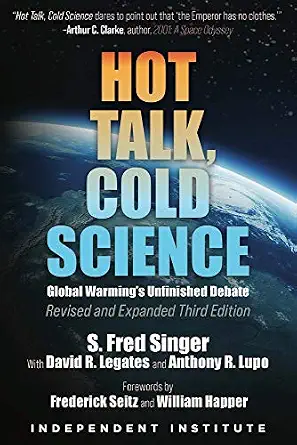
Dr. S. Fred Singer, an atmospheric and space physicist, is one of the world's most respected and widely published experts on climate. He is professor emeritus of environmental science at the University of Virginia. He directs the nonprofit Science and Environmental Policy Project, which he founded in 1990 and incorporated in 1992 after retiring from the University of Virginia. Dr. Singer served as professor of environmental sciences at the University of Virginia, Charlottesville, VA (1971-94); distinguished research professor at the Institute for Space Science and Technology, Gainesville, FL, where he was principal investigator for the Cosmic Dust/Orbital Debris Project (1989-94); chief scientist, U.S. Department of Transportation (1987- 89); vice chairman of the National Advisory Committee for Oceans and Atmosphere (NACOA) (1981-86); deputy assistant administrator for policy, U.S. Environmental Protection Agency (1970-71); deputy assistant secretary for water quality and research, U.S. Department of the Interior (1967- 70); founding dean of the School of Environmental and Planetary Sciences, University of Miami (1964-67); first director of the National Weather Satellite Service (1962-64); and director of the Center for Atmospheric and Space Physics, University of Maryland (1953-62). Dr. Singer did his undergraduate work in electrical engineering at Ohio State University and holds a Ph.D. in physics from Princeton University. Dr. Singer has published more than 200 technical papers in peer-reviewed scientific journals, including EOS: Transactions of the AGU, Journal of Meteorology and Atmospheric Physics, Science, Nature, Bulletin of the American Meteorological Society, Geophysical Research Letters, and International Journal of Climatology. His editorial essays and articles have appeared in Cosmos, The Wall Street Journal, New York Times, New Republic, Newsweek, Journal of Commerce, Washington Times, Washington Post, and many other publications. His accomplishments have been featured in front-cover stories appearing in Time, Life, and U.S. News & World Report Dr. Singer is author, coauthor, or editor of more than a dozen books and monographs, including Global Effects of Environmental Pollution (Reidel, 1970), Is There an Optimum Level of Population? (McGraw-Hill, 1971), Free Market Energy (Universe Books, 1984), Global Climate Change (Paragon House, 1989), The Greenhouse Debate Continued: An Analysis and Critique of the IPCC Climate Assessment (ICS Press, 1992), Hot Talk Cold Science - Global Warming's Unfinished Debate (Independent Institute, 1997, 1999), Climate Policy - From Rio to Kyoto (Hoover Institution, 2000), Unstoppable Global Warming - Every 1,500 Years (Rowman & Littlefield, 2007, revised ed. 2008), Nature, Not Human Activity, Rules the Climate (Heartland Institute, 2008), and Climate Change Reconsidered: The 2009 Report of the Nongovernmental International Panel on Climate Change (Heartland Institute, 2009). Dr. Singer is an elected Fellow of the American Association for the Advancement of Science (AAAS), American Geophysical Union, American Physical Society, and American Institute for Aeronautics and Astronautics. He was elected to the AAAS Council and served on the Committee on Council Affairs, and as Section Secretary. In 1997, NASA presented Dr. Singer with a commendation and cash award "for important contributions to space research." Dr. Singer has given hundreds of lectures and seminars on global warming, including to the science faculties at Stanford University, University of California-Berkeley, California Institute of Technology, State University of New York-Stony Brook, University of South Florida-St. Petersburg, University of Connecticut, University of Colorado, Imperial College-London, Copenhagen University, University of Rome, and Tel Aviv University. He has also given invited seminars at Brookhaven National Laboratory, the Max Planck Institute for Extra-Terrestrial Physics in Munich, the Max Planck Institute for Meteorology in Hamburg, and the National Center for Atmospheric Research in Boulder, Colorado. Dr. Singer has been a pioneer in many ways. At the Applied Physics Laboratory of Johns Hopkins University, he participated in the first experiments using high-altitude research rockets, measuring the energy spectrum of primary cosmic rays and the distribution of stratospheric ozone; he is generally credited with the discovery of the equatorial electrojet current flowing in the ionosphere. In academic science during the 1950s, he published the first studies on subatomic particles trapped in the Earth's magnetic field - radiation belts, later discovered by James Van Allen. Dr. Singer was the first to make the correct calculations for using atomic clocks in orbit, contributing to the verification of Einstein's General Theory of Relativity, and now essential in the GPS system of satellite navigation. He also designed satellites and instrumentation for remote sensing of the atmosphere and received a White House Presidential Commendation for this work. In 1971, Dr. Singer calculated the anthropogenic contribution to atmospheric methane, an important greenhouse gas. He also predicted that methane, once reaching the stratosphere, would transform into water vapor, which could then deplete stratospheric ozone. A few years later, methane levels were indeed found to be rising, and the increase in stratospheric water vapor was confirmed in 1995.