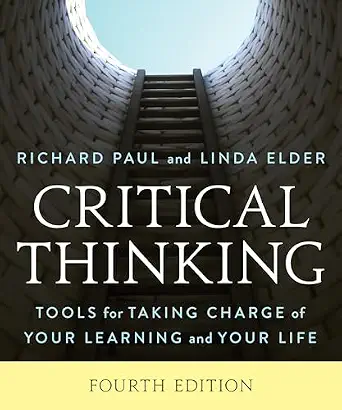
Critical Thinking: Tools for Taking Charge of Your Learning and Your Life by Richard Paul
Current edition description Written by two of the leading experts in critical thinking, this book focuses on an integrated, universal concept of critical thinking that is both substantive and applicable to any and every situation in which human thinking is necessary. It provides readerse with the basic intellectual tools needed for life-long learning, helping them understand the mind and how its three functions ― thinking, feeling, motivation ― influence and are influenced by one another. This book fosters the development of fair-minded critical thinking. Features the intellectual standards: clarity, precision, accuracy, logicalness, significance, depth, breadth, and fairness; The importance of good questioning; and intellectual tools to read for deep and lasting comprehension, and to write in ways that show clarity of reasonability of thought. For all that want to improve their critical thinking skills to apply to their job or life. The text features: Think for Yourself activities – throughout each chapter. (Ex. pp 29, 127). ~Help students take ownership of basic concepts as they learn them. Practical and learnable format. ~Simplifies complex ideas to make learning easier for students. Focus on thinking across the disciplines. (Ex. pp 119-120). ~Helps students to think within the various disciplines, rather than memorizing facts. Students are taught to learn to think like an historian, like a scientist, like a psychologist, etc. Critical thinking focus – When students internalize intellectual standards – such as clarity, precision, accuracy, logicalness, significance, depth, breadth, and fairness – they use them on a daily basis to upgrade their thinking, and to assess the thinking of others. (Ex. 12, 152). ~Gives students intellectual standards they can use in every dimension of their thinking. Features intellectual tools to read for deep and lasting comprehension, and to write in ways that show clarity of reasonability of thought. (Ex. 133). ~Teaches students to read closely and write substantively. Good questions are the key to good thinking – Thinkers who know how to ask relevant questions in context are better able to think their way through complex issues. (Ex. pp 83, 87, 93). ~Teaches students to ask the questions the best thinkers ask. Website – www.criticalthinking.org. ~Links students to the world’s largest and most prestigious critical thinking website and provides forums for student and faculty discussions. International approach – with translations into German, French, Spanish, Japanese, Chinese, Russian, and Malay. ~Provides students with the opportunity to read portions of the text in their native language. "This book is well-written, lucid and contains abundant examples and applications that not only enliven the subject matter but present relevant contexts for building understanding and advanced critical thinking. In addition, it is faithful to the complexity and work required to improve one's thinking. It does not soft-pedal the challenge but actually throws down the gauntlet to the worthy Reader to pick it up." --Stephen J. Knopp, Ph.D., Ohio University "This concise version is a more comprehensive and robust textbook. Many Critical Thinking books cover thinking from a narrow angle, but Paul and Elder offer a model of critical thinking that can be applied not only to academic disciplines but also to life in general." --Connie Wolfe, Surry Community College
Categories: Creative Thinking / Creativity